

I’ve relied heavily on SEO throughout my career as a SaaS founder.
I used it to grow StandOut CV to more than 18 million organic visits, 23,000 paying customers and over £1 million in subscription revenue.
During that time, I’ve used or tested most of the major keyword research tools out there.
Good tools make an enormous difference to SaaS keyword research, but simply having access to more data does not guarantee a better strategy.
Based on my experience using and testing these platforms, here are the seven best keyword research tools for SaaS companies. I’ve included a mixture of comprehensive SEO platforms and more specialised tools, each suited to a different part of the keyword research and planning process.
SaaS Keyword Research Tools – Quick Comparison
| Tool | Best for | Core features | Pricing |
|---|---|---|---|
 RevPages RevPages | Finding and prioritising revenue-generating SaaS pages | SaaS opportunity discovery, revenue forecasting, prioritisation, roadmaps and content briefs | Free to try |
| Ahrefs | Detailed competitor and SERP research | Keywords Explorer, Site Explorer, Content Gap, backlink analysis and rank tracking | Starter $29/month; Lite $129/month |
 Semrush Semrush | Managing a complete SEO campaign | Keyword Magic Tool, Keyword Gap, clustering, rank tracking and site audits | From $139.95/month |
| SE Ranking | An affordable all-in-one SEO platform | Keyword research, competitor analysis, rank tracking, content tools and site auditing | Core from €109/month |
| LowFruits | Finding easier long-tail keywords | Keyword discovery, weak-spot analysis, SERP difficulty and clustering | From $25 pay-as-you-go or $79.90/month |
| Keyword Insights | Turning large keyword lists into a content plan | Keyword discovery, SERP-based clustering, intent analysis and content briefs | From $58/month |
| Google Keyword Planner | Free keyword and paid-search data | Keyword ideas, search-volume estimates, forecasts, competition and bid data | Free with a Google Ads account |
1. RevPages
Best for: Finding and prioritising high-intent SaaS keyword opportunities
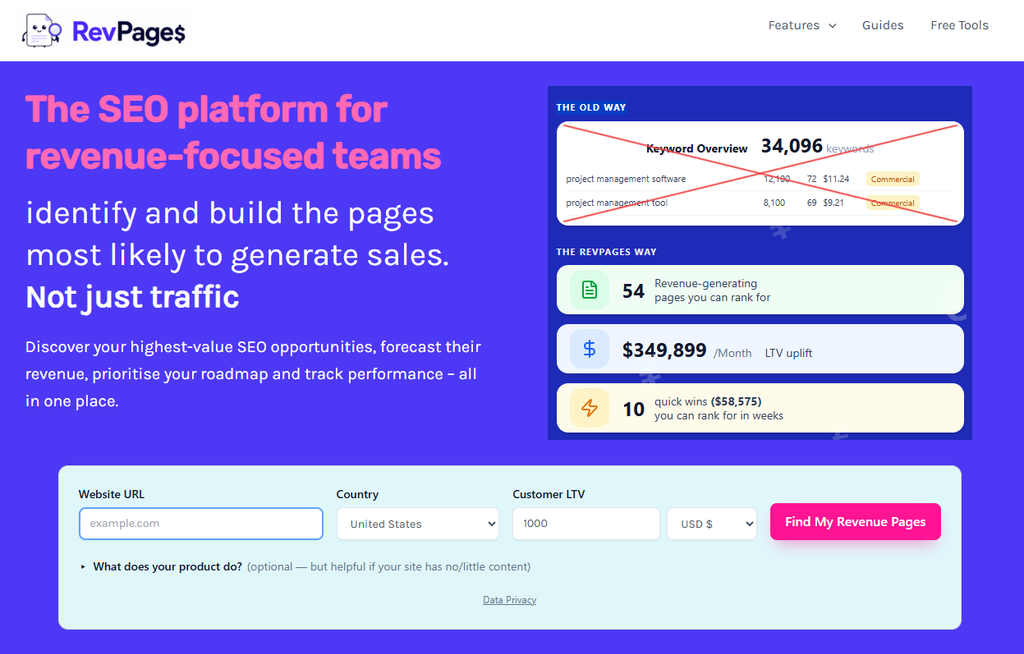
I built RevPages because I kept running into the same problem with conventional keyword research tools.
They were very good at giving me data, but they still left me to work out which keywords were genuinely valuable to the business.
When researching SEO opportunities for a SaaS company, I don’t want a spreadsheet containing 10,000 vaguely related searches. I want to know which pages could realistically generate customers.
RevPages is designed to answer that question.
You enter your website, target country and average customer lifetime value. It analyses the business and returns a focused list of commercially valuable pages that you could create or improve – and forecasts their revenue.
What RevPages Does
- Finds high-intent feature, use-case, industry, comparison, alternative, category and template keywords
- Forecasts the potential revenue available from pages built for those keywords
- Checks your current rankings and calculates the potential uplift from improving them
- Prioritises opportunities using revenue potential, keyword difficulty and ranking achievability
- Turns selected opportunities into a content roadmap with AI-generated briefs
Why It’s Good for SaaS Keyword Research
- It understands common SaaS page types: RevPages actively looks for features, use cases, industries, competitors and software categories rather than returning a generic list of related phrases – making it the only true SaaS keyword research tool available at the moment.
- It focuses on buying intent: It prioritises the searches most likely to generate trials, demos and customers instead of simply chasing the largest traffic numbers.
- It connects keywords to revenue: Forecasts use search demand, expected click-through rates, estimated conversion rates and customer lifetime value.
- It finds optimisation opportunities: RevPages identifies existing pages within striking distance as well as entirely new pages that could be created.
- It produces an actionable plan: The strongest opportunities can be placed directly into a prioritised roadmap rather than disappearing into another spreadsheet.
Where It Falls Short
RevPages is intentionally more focused than a traditional all-in-one SEO platform.
It does not provide the enormous keyword database, technical auditing or extensive backlink analysis available from Ahrefs and Semrush. If I want to investigate a competitor’s backlink profile or dig deeply into an individual SERP, I will still use Ahrefs.
RevPages is best used to decide what to create, what to improve and what to prioritise. It is not designed to replace every SEO tool in your stack.
Price
Free to try; paid monthly pricing coming soon.
2. Ahrefs
Best for: Detailed competitor, keyword and SERP research
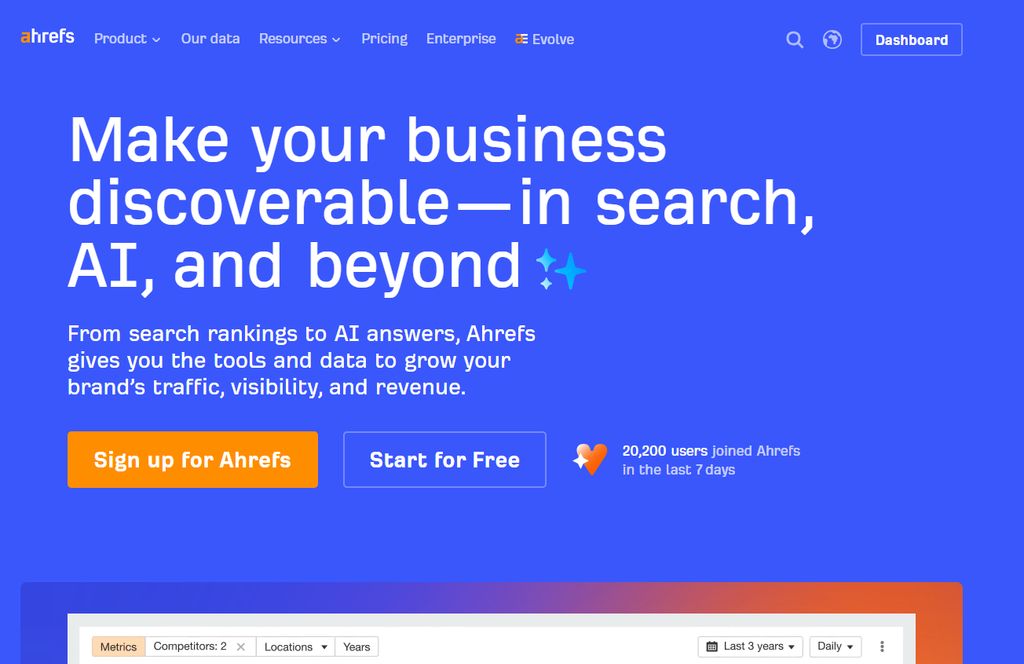
Ahrefs is the SEO tool I use most often.
I use it virtually every day to inspect search results, assess websites, find competing pages, investigate backlinks and check whether a keyword opportunity is as attractive as it initially appears.
Keywords Explorer gives you the usual metrics such as volume, keyword difficulty and CPC, but the real value comes from combining this with Site Explorer, Content Gap and the platform’s backlink data.
If I want to understand how a competitor is generating organic traffic, Ahrefs is normally the first tool I open.
What Ahrefs Does
- Generates keyword ideas with search volume, difficulty, CPC and traffic-potential data
- Reveals the keywords and pages generating traffic for competing SaaS websites
- Finds terms that competitors rank for but your website does not
- Shows the ranking pages, backlink profiles and history of individual search results
- Tracks rankings and monitors changes in organic visibility
Why It’s Good for SaaS Keyword Research
- Excellent competitor analysis: You can find which feature, alternative, comparison and industry pages are already working for rival SaaS companies.
- Strong Content Gap reporting: Comparing several competitors can expose important topics missing from your site.
- Detailed SERP analysis: Ahrefs makes it easy to see the authority, backlinks and estimated traffic of every ranking page.
- Traffic Potential is useful: A page may rank for hundreds of related phrases, so its total traffic potential can be more informative than the volume of one keyword.
- Backlink data adds context: You can estimate whether an opportunity will require content alone or a significant link-building campaign.
Where It Falls Short
Ahrefs gives you a huge amount of information, but it does not always make the final decision for you.
You can easily export thousands of competitor keywords and still be unsure where to begin. Its metrics are useful, but search volume and keyword difficulty do not tell you how valuable a visitor will be to your SaaS business.
The $29 Starter plan is useful for occasional research, but regular professional use will normally require the more expensive Lite plan or above.
Price
Starter costs $29 per month, while the fuller Lite plan costs $129 per month.
3. Semrush
Best for: Broad keyword research and complete SEO campaign planning
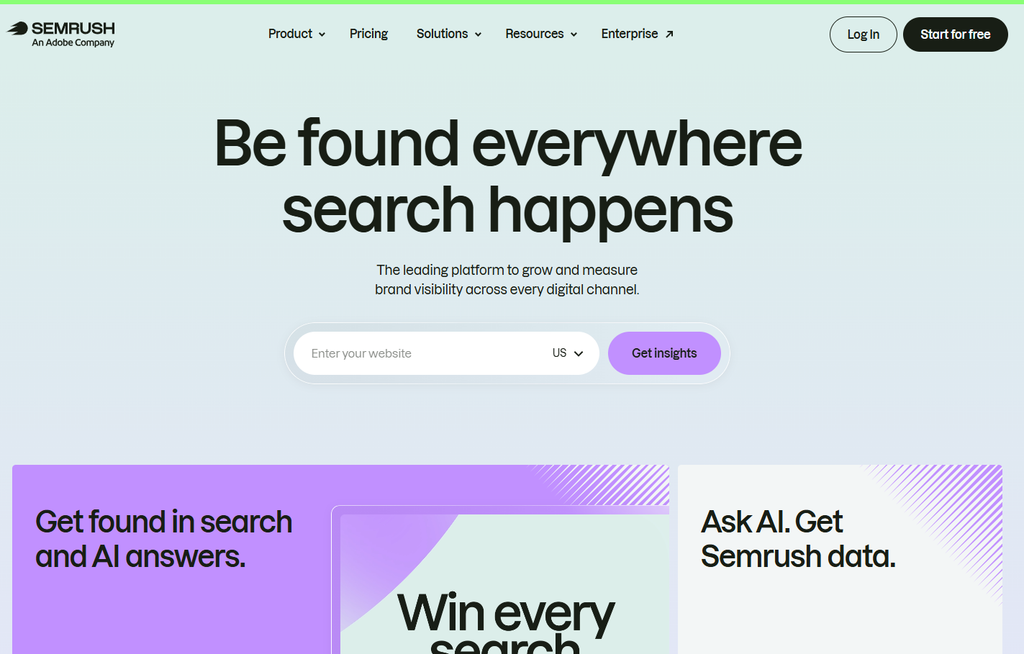
Semrush is probably the closest direct alternative to Ahrefs.
I’ve used it for keyword research, competitor analysis and content planning. It is a very broad platform, with tools for SEO, paid search, content, technical auditing and visibility monitoring.
Its Keyword Magic Tool is useful when you want to take a product category or seed phrase and expand it into a much larger list. Keyword Gap then lets you compare your website against competing SaaS businesses.
Keyword Strategy Builder is particularly useful for turning those discoveries into topic clusters and a more structured content plan.
What Semrush Does
- Generates large keyword lists through Keyword Magic Tool
- Compares your rankings against several competitors using Keyword Gap
- Groups related keywords into pillar pages and subpage clusters
- Tracks rankings, SERP features and competitor movements
- Provides technical audits, backlink data and on-page SEO recommendations
Why It’s Good for SaaS Keyword Research
- It covers the whole customer journey: You can research commercial product terms alongside informational topics that support buyers earlier in their research.
- Keyword Gap is easy to use: It quickly shows where competitors have visibility that your SaaS website lacks.
- It helps organise large sites: Keyword Strategy Builder maps related phrases into clusters and suggested pages.
- It combines SEO and PPC information: This is helpful when paid-search performance is being used to validate organic landing-page opportunities.
- It supports wider campaign management: Research, tracking, technical SEO and content planning can all be managed from the same platform.
Where It Falls Short
Like Ahrefs, Semrush can overwhelm you with data.
Its broad range of features also means that you may pay for tools you rarely use. If you only need simple keyword research, LowFruits or Google Keyword Planner will cost considerably less.
I also find Ahrefs slightly more intuitive for quickly inspecting a website’s best pages, backlinks and competing search results. That is partly personal preference, but it is the reason Ahrefs remains my daily tool over SEMrush.
Price
The Semrush SEO Toolkit starts at $139.95 per month.
4. SE Ranking
Best for: An all-in-one SEO platform for teams that want a cheaper alternative to Ahrefs or Semrush
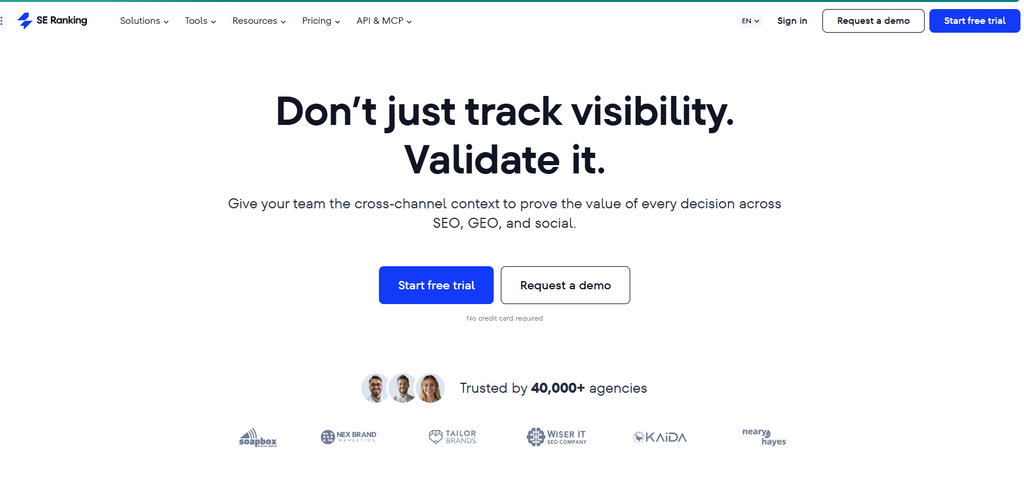
SE Ranking provides many of the core capabilities of the larger SEO suites, including keyword research, competitor analysis, rank tracking, website auditing and content tools.
I have tried SE Ranking and found it covers an impressive amount of the SEO workflow in one platform. It is particularly good for teams that want competitor and ranking data without the high price tags of Ahrefs or SEMrush
Its keyword tools can be used to expand seed topics, analyse search demand and difficulty, inspect current results and uncover phrases for which competing SaaS businesses already rank.
What SE Ranking Does
- Finds keyword ideas and provides volume, difficulty and CPC data
- Analyses competitors’ organic keywords, pages and estimated traffic
- Tracks rankings across different countries, locations and devices
- Audits technical SEO problems across a website
- Supports content planning and on-page optimisation
Why It’s Good for SaaS Keyword Research
- Strong all-round coverage: It handles discovery, competitor research, tracking and auditing within one product.
- Useful for international SaaS companies: Teams can research and monitor search performance across multiple countries.
- Competitor research reveals proven pages: You can find product and content ideas already generating visibility for other SaaS brands.
- Accurate rank tracking supports optimisation: It is useful for monitoring commercially important feature, comparison and industry pages.
- Suitable for agencies: Project management and reporting features make it practical when handling several SaaS clients.
Where It Falls Short
SE Ranking is broad, but I would still choose Ahrefs when I need the deepest backlink and competitor analysis. I find that SEranking just doesn’t have the same volume of data as Ahrefs and sometimes misses important SERP data or backlinks.
It can also suffer from the same problem as most general keyword platforms: it provides metrics and suggestions, but the marketer must decide which terms have the greatest commercial value.
Price
The Core plan is currently listed at €109 per month when billed monthly.
5. LowFruits
Best for: Finding low-competition keywords that a smaller SaaS site could rank for
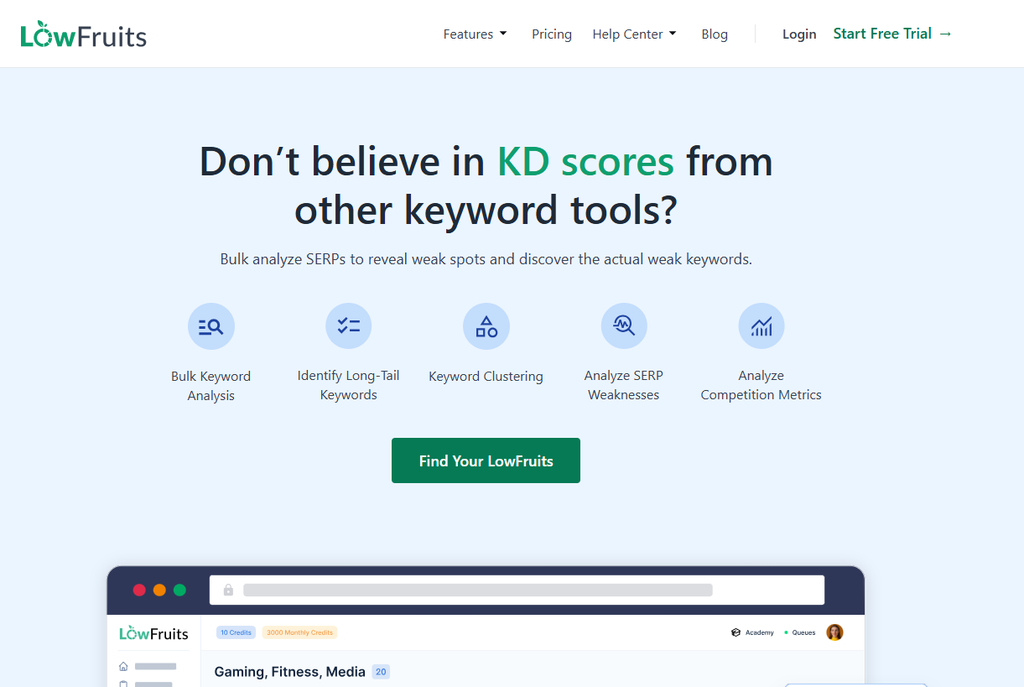
LowFruits takes a more focused approach to keyword research.
Instead of trying to be a complete SEO platform, it concentrates on finding long-tail searches where the current Google results contain obvious weak spots.
A weak spot might be a lower-authority website, a forum, a user-generated page or another result that suggests Google does not have many strong pages to choose from.
I have tried LowFruits and think it is particularly useful for newer SaaS companies. A young website may have little chance of ranking for a huge category term, but it can often compete for narrower use-case or industry searches.
What LowFruits Does
- Generates long-tail keyword ideas from seed topics
- Analyses search results in bulk to identify weaker competing sites
- Calculates SERP difficulty scores
- Groups closely related keywords into clusters
- Extracts keyword opportunities from competing websites and sitemaps
Why It’s Good for SaaS Keyword Research
- It finds realistic starting points: New SaaS sites can avoid wasting time on keywords dominated by major brands.
- It works well for niche use cases: Specific feature, industry and problem-led searches often have lower competition.
- SERP weakness is made visible: You are not relying entirely on a single keyword difficulty number.
- It helps build early traction: A collection of smaller commercial wins can grow authority before you tackle bigger category terms.
- Pay-as-you-go pricing is flexible: You do not necessarily need another permanent monthly subscription.
Where It Falls Short
LowFruits is best at finding weaker search results, not determining whether those searches will generate meaningful SaaS revenue.
Low competition should never be the only reason to target a keyword. You still need to check that the topic is relevant to the product and likely to attract a potential buyer.
Its keyword and competitor databases are also not as extensive as those offered by Ahrefs or Semrush.
Price
Pay-as-you-go packages start at $25 for 2,000 credits, while the Premium subscription is $79.90 per month.
6. Keyword Insights
Best for: Clustering keywords and turning research into content briefs
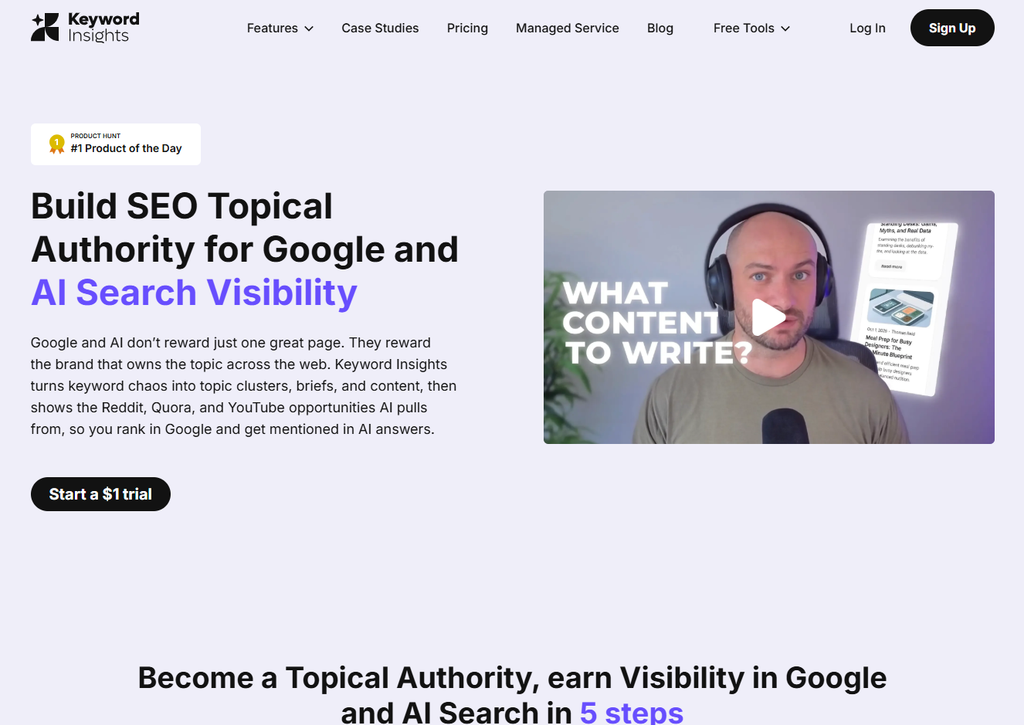
Keyword Insights is most useful when you already have a substantial keyword list and need to work out what to do with it.
This is a common problem in SaaS SEO.
You might find “CRM for recruiters”, “recruitment CRM software”, “best CRM for recruitment agencies” and dozens of similar phrases. The next question is whether they require separate pages or whether they can all be targeted together.
Keyword Insights groups terms based on overlap between the pages currently ranking in Google. This is generally more reliable than clustering phrases simply because they contain similar words.
What Keyword Insights Does
- Discovers keywords using sources such as Google Autocomplete and People Also Ask
- Groups keywords according to overlap in their search results
- Classifies the dominant search intent within each cluster
- Recommends primary keywords for individual pages
- Turns clusters into AI-assisted content briefs and outlines
Why It’s Good for SaaS Keyword Research
- It prevents keyword cannibalisation: Closely related searches can be consolidated into one stronger page.
- It reveals genuine intent differences: Similar-looking keywords may produce different results and require separate pages.
- It turns spreadsheets into a site plan: Teams can see which pages need to be created rather than staring at thousands of rows.
- It supports scalable production: Clusters can be moved directly into briefs for internal writers or freelancers.
- It is useful for complex SaaS topics: Products with many features, industries and use cases can organise their coverage more logically.
Where It Falls Short
Keyword Insights is not my first choice for detailed competitor, backlink or authority analysis.
Its value becomes clearest once you already have a sizeable list to organise. If your main problem is finding a small number of high-intent SaaS opportunities, RevPages offers a more direct starting point.
Clustering can also create a false sense of certainty. Search results change, and editorial judgement is still needed when deciding whether two terms should share a page.
Price
The Basic plan costs $58 per month and includes 10,000 credits.
7. Google Keyword Planner
Best for: Free keyword ideas and Google Ads data
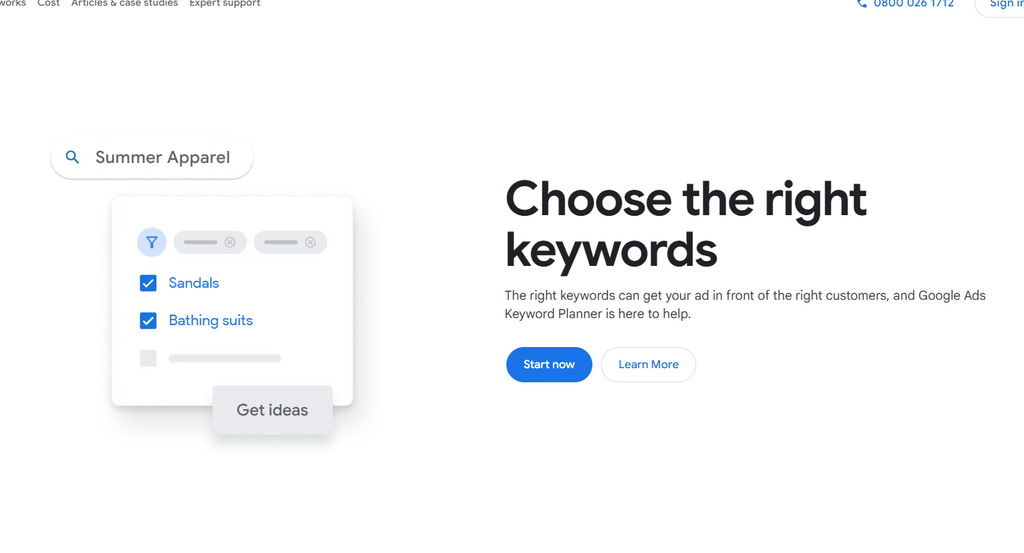
Google Keyword Planner is primarily designed for paid-search advertisers, but it can still be useful for SaaS SEO research.
I would not rely on it as my only keyword tool, but it is a helpful free source of ideas, search-demand estimates and advertising data.
Because the tool is part of Google Ads, its CPC and advertiser-competition information can provide clues about commercial intent. A keyword attracting expensive bids from several software companies is often worth investigating for organic search as well.
What Google Keyword Planner Does
- Generates ideas from words, phrases and website URLs
- Provides estimated monthly search ranges
- Shows historical trends and changes in demand
- Supplies suggested bid and advertiser-competition information
- Creates forecasts for uploaded keyword lists
Why It’s Good for SaaS Keyword Research
- It is free: Any SaaS founder can begin researching a market without paying for a specialist SEO platform.
- It comes directly from Google: The data is designed for Google Ads planning rather than being modelled by a third-party SEO tool.
- CPC provides a commercial signal: High advertiser bids can indicate that a search has value to competing businesses.
- Website-based discovery is useful: You can enter a competitor’s page to generate related ideas.
- It helps connect PPC and SEO: Paid campaigns can be used to test the conversion potential of keywords before committing to organic pages.
Where It Falls Short
Keyword Planner was built for advertising, not organic SEO.
It does not provide a meaningful organic keyword difficulty score, backlink analysis or detailed information about the strength of ranking pages. Search volumes may also be shown as broad ranges, particularly on accounts with little advertising activity.
It can suggest what people search for, but you will need another tool to judge whether your SaaS website can rank and how each opportunity fits into a wider content roadmap.
Price
Free to use with a Google Ads account.
How to Pick the Right Keyword Research Tools for Your SaaS
I don’t think there is one keyword research tool that does everything perfectly.
The right choice depends on the question you need to answer.
If you want to identify the SaaS pages most likely to generate customers, revenue and ROI use RevPages.
If you want to investigate competitors, backlinks and individual search results in detail, Ahrefs is my preferred option.
If you want a broad platform for managing keyword research alongside the rest of an SEO campaign, look at Semrush or SE Ranking.
For a newer website trying to find realistic long-tail opportunities, LowFruits is useful. If you already have thousands of keywords and need to turn them into a clean page plan, Keyword Insights is the better fit.
Finally, Google Keyword Planner remains a useful free starting point, particularly when you want to compare organic ideas with evidence from paid-search activity.
In practice, I normally recommend combining two types of tool:
- A broad research platform that gives you reliable keyword and competitor data.
- A more focused tool that helps you turn that data into decisions and an actionable roadmap.
The most important thing is not how many keywords a platform can find. It is whether the tool helps you identify relevant, achievable searches that can eventually turn into trials, customers and revenue.